2026 Q2 Newsletter
Letter from the Editor
Dear Friends of LOFC,
A Significant Gift
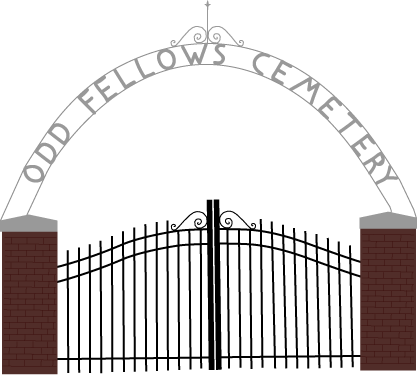
If you have visited LOFC recently, you have noticed major improvements underway on the cemetery grounds. Patty Povall Lewis—yes, my beautiful and accomplished sister—and her husband, William, owner along with their three children of the iconic J. E. Neilson in Oxford, have made a substantial donation to fund new entrance gates and wrought iron fencing to replace the old cyclone fence. We have engaged Iron Innovations of Clinton, Mississippi, an experienced manufacturer of custom wrought iron gates and fencing, to complete the work. The company has removed the old cyclone fencing and gates at the Main and North entrances and is sandblasting the gates to strip away at least eight coats of paint. New wrought iron frames will be added so the gates fit the wider entrance openings now needed. Iron Innovations’ mason has already built new brick columns using brick that resembles old brick. The two entrance gates will be solar powered and set to open and close on a schedule. Patty and William are also funding a new Odd Fellows arch over the North Gate to match the existing arch at the Main Gate. They are replacing one service gate, and Julian Watson, who has served as Chairman of the Board since LOFC was founded, is replacing the second. Leath Johnson, our treasurer, is paying for decorative finials on the fencing. Harold Hammett funded the clearing of the old fence line to allow for its removal, and Ed and Fran Thurmond paid to clear debris along Rockport Road to create a more attractive entrance. We are deeply grateful to everyone who has contributed to this project, and we look forward to its completion. It will be a beautiful and lasting improvement for years to come. Stay tuned -- I hope to share photographs in our next newsletter.
Calling All Gwin Relations and Descendants
Continuing from our last newsletter, I want to return to Diane T. Feldman’s book on Holmes County, Borrowed Land, Stolen Labor, and the Holy Spirit. Feldman writes that by the end of the 1830s, all land in Mississippi once held by Native Americans had been sold to new owners. Many were speculators who kept the land only briefly before selling at a profit. Others held their property and profited from cotton cultivation. Those who controlled large tracts became Holmes County’s new elite and helped populate the county with enslaved people brought from other places. These new landowners were white and often recent arrivals from the Carolinas, Virginia, and farther north. One such early family was the Gwin family.
President Andrew Jackson appointed Samuel Gwin as Mississippi’s federal land agent, though the Senate never confirmed him. It is believed that Samuel Gwin established a trading post in the early 1820’s on what is said to be the geographical center of Holmes County on the west side of town. Samuel’s brother, William McKendree Gwin, had earlier served for a time as Jackson’s personal secretary before becoming federal marshal for Mississippi. William McKendree Gwin later served as a Mississippi congressman and then moved west, where he became a U.S. Senator from California. He is best known for his efforts to establish a Confederate colony in Mexico.
Julia Zemp Kjaerstad, a maternal descendant of the Gwin family, has been especially helpful in providing family history for this newsletter. She and her Norwegian husband, Thorbjoern (known to the locals in Lexington as KJ), divide their time between Lexington and Norway. According to Julia, James Madison Gwin, a cousin of William McKendree Gwin, was living at Sweet Water Farm outside Lexington in 1836. He donated two acres near Chenoa for the first Episcopal church in Holmes County. He and his wife, Susannah Davis Van Houten Gwin, are buried in LOFC. They had four children, including John Edgar Gwin, who studied law and graduated from the University of Louisiana in 1866, practiced law in Lexington, and served as both a planter and a legislator.
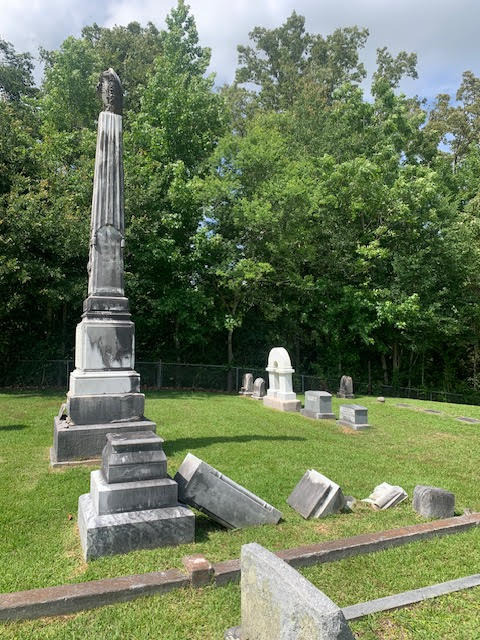
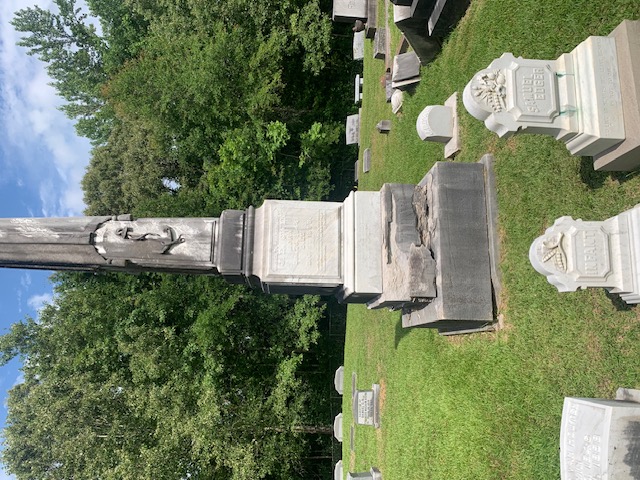
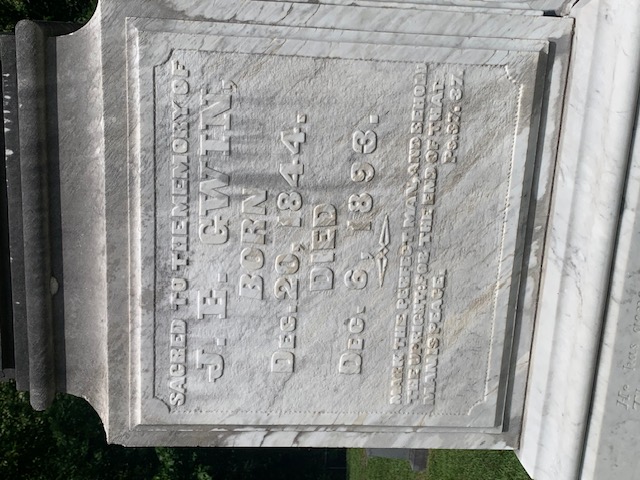
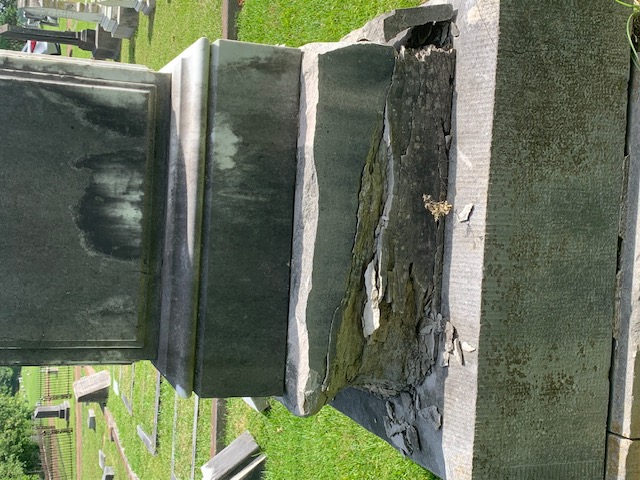
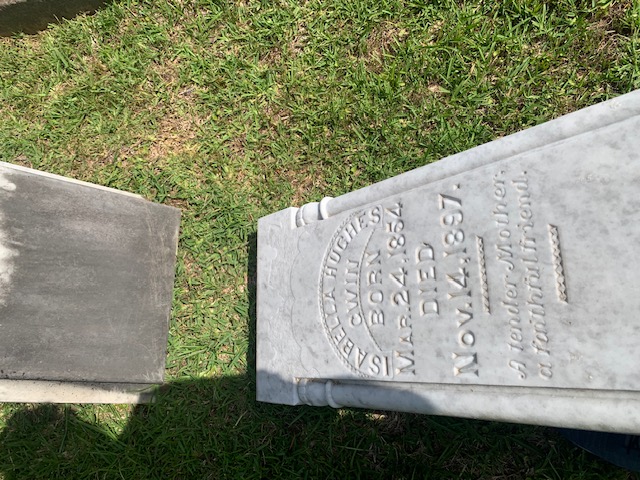
John Edgar Gwin married Leda Rebecca Gage in 1869, and they had two daughters. In 1875, they built a grand house on North Street in Lexington. Leda died in 1878 at just 26 years old and is buried in LOFC near her Cochran relatives. In 1881, John Edgar remarried Isabella Hughes. They had seven children, though only three daughters survived infancy. John Edgar died in 1893 and is buried in LOFC as well. His obelisk in the old section is the tallest monument in the cemetery, where several of their children are also buried.
The National Register of Historic Places describes the house John Edgar built as a strong example of the Queen Anne style that was popular in the late nineteenth and early twentieth centuries. The house was irregularly massed, with multiple gables and dormers rising from a central hipped roof. Its façade featured a two-story bay on the right side and double porches with turned cutwork posts, brackets, spandrels, balusters, decorative wood shingles, and cutwork in the gable ends. Gwin’s choice of such an elaborate and costly Victorian design suggests that he was prospering in Lexington within a decade of the Civil War’s end. The house and its outbuildings originally occupied a full city block on the northeast edge of town in what appears to have been an upscale postbellum neighborhood. Sanborn Insurance Maps from 1886 through 1925 did not include that edge of town until 1925, and even then, the map showed only two blocks of North Street, without yet including the Gwin/Noel house block.
Following John Edgar Gwin’s death, the house on North Street was deeded in 1899 to Margaret Ann Noel, mother of Edmund Favor Noel. After her death in 1904, Edmund Favor Noel inherited the property. Unmarried at the time, Noel hosted President Theodore Roosevelt during Roosevelt’s legendary bear hunt near Onward. Noel married Alice Tye Neilson in 1905 and is believed to have named the house “Oak Hill” when he filed a homestead declaration that same year. He later served as Governor of Mississippi from 1908 to 1912 before returning to the house. The Neo-Classical reworking of the façade may have taken place after his return from Jackson, when that style was especially popular among prominent citizens in Mississippi towns. Governor Noel died in the house in 1927 and is buried in LOFC. Mrs. Noel remained there until her death in 1955, after which her son from a previous marriage inherited the property. The house later passed in and out of the family until Pat and Joyce Barrett purchased it in 1989. It is now owned by Janice Barrett, widow of Pat Barrett, Jr., a founding member of the LOFC board.
Julia also relates that John Edgar’s oldest daughter, Susie Davis Gwin, married Levi Crow Peets of Wilkinson County, and they had three children: Leda, Edgar, and George Halsey. In October 1909, Susie and her three children moved to Lexington to stay with her sister, Julia Alice Gwin Clower. Julia Alice and her husband, Benjamin Franklin Clower, had purchased the house where Julia grew up on Old Tchula Road, presently Old Tchula Street, from the Beck family in 1903; until then, they had lived at Sweet Water Farm. Around noon on December 31, 1909, a terrible accident occurred there. Edgar Gwin Clower and Edgar Gwin Peets were playing in the hall when Edgar Gwin Clower shot his cousin in the face. Both boys believed the shotgun was unloaded. According to family history, Edgar Gwin Peets died later that afternoon and was buried in Odd Fellows Cemetery. However, Julia has been unable to locate his grave, and our database contains no record of the grave.
Julia Alice Gwin, Julia’s great-grandmother and namesake, married Benjamin Franklin Clower in 1895. They lived at Sweet Water Farm until their children reached school age, when the family moved to Lexington in 1903. Benjamin Franklin Clower grew up in what is now known as the Lundy House. They had three children: Edgar Gwin Clower, Annie Elizabeth—Julia’s grandmother—and Julia Alice. Annie Elizabeth married Billie Forbus Harthcock in 1920, and they spent their entire married life at Gum Grove Plantation near Thornton. They had five children, including Julia’s mother, Elizabeth Anne Harthcock Zemp, and Frances Gwendolyn Harthcock Matthews. Their three other children died in infancy and were buried in Odd Fellows. Julia’s parents are buried there as well, beside her grandparents.
My brother Al Povall recalls that there were Gwin descendants living in the west end of Lexington and assumes that many were descendants of Sam Gwin from whom they possibly inherited their land. Amma and Necie Gwin worked in the Lexington school lunchroom. After the war my parents rented the second floor of a house on Boulevard, known in our family as the “wasp house” for it was infested with wasps. Amma and Necie lived down the street. Al, as a young boy of four, would walk down to their house with his dog Jake, knock on the door, and say, “me and my dog Jake just love your chawn bread,” to which Amma and Necie would kindly share their famous cornbread sticks. Erin Gwin, later Lail, with her mother, Mary, lived just to the west of Amma and Necie.
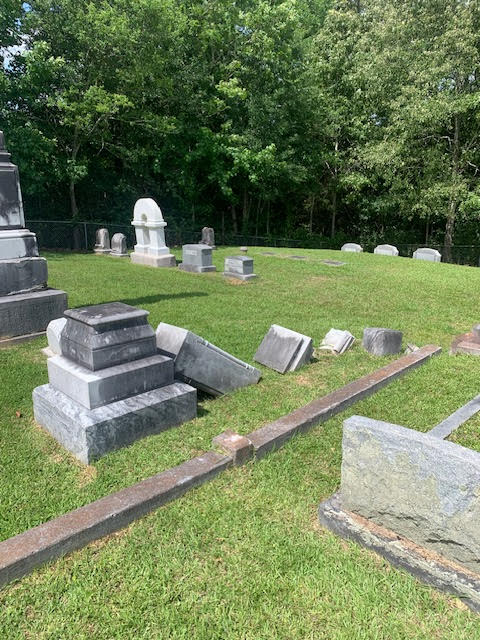
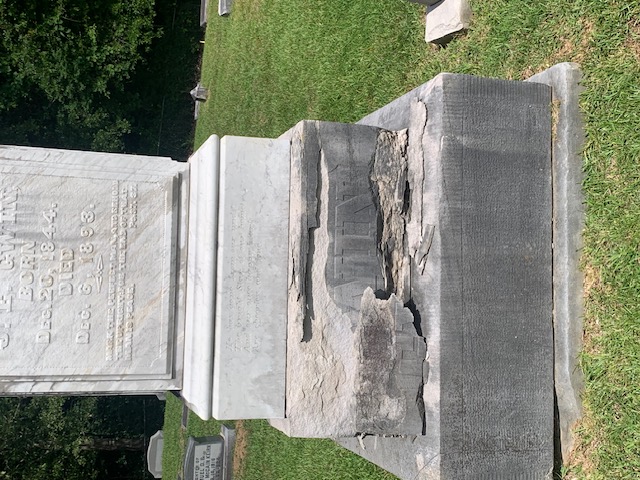
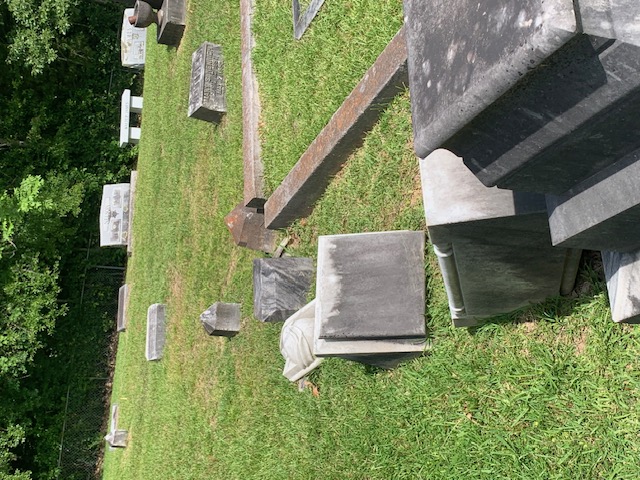
More people with the surname Gwin are buried in LOFC than members of any other family -- a total of 66. If you visit our website and search “Gwin” under Memorials, you will find a list of all Gwins buried in LOFC. As noted above, John Edgar Gwin died in 1893, and his grave is marked by the tall obelisk that now urgently needs restoration before it falls. Photographs of Gwin monuments in need of repair appear below. If you are a Gwin descendant or relative and would like to help restore the Gwin family monuments, please consider donating. You may do so through the giving page on our website https://lexingtonoddfellowscemtery.com or by mailing a tax-deductible check to LOFC, P.O. Box 1213, Lexington, MS 39095, noting that the gift is for Gwin Monument Restoration.
With kind regards, I am
Amanda Povall Gibbs, Editor
To Donate by check
Please mail your tax-deductible checks to:
Lexington Odd Fellows Cemetery, Inc.
PO Box 1213
Lexington, MS 39095-1213
To Donate online
CLICK HERE TO MAKE YOUR ONLINE DONATION
To Join the LOFC Maintenance Club
(Make a monthly recurring donation for ongoing maintenance)
CLICK HERE TO JOIN THE MAINTENANCE CLUB
Lexington Odd Fellows Cemetery, Inc. is a 501(c)13 organization, and your gifts are deductible as charitable contributions for federal income tax purposes.
Gwin Family Monuments Needing Restoration

Lexington Odd Fellows Cemetery, Inc.’s mission is to preserve and maintain the historic Odd Fellows Cemetery. Contributions raised assist LOFC in accomplishing our mission.
Copyright © 2026 Lexington Odd Fellows Cemetery, Inc.